



Digital identity infrastructure is becoming a bigger part of Canada’s payments conversation — not because consumers are suddenly asking for new login systems, but because financial platforms are running into something far more immediate: verification fatigue.
Across fintech, digital banking, online payments, and regulated gaming services, onboarding has become increasingly layered. Identity checks, document uploads, device monitoring, authentication codes, and fraud screening tools now sit inside customer journeys that once took only a few minutes.
That pressure is pushing more organizations to revisit a long-running question inside Canada’s digital infrastructure sector: whether reusable identity systems and credential frameworks could eventually reduce friction without weakening security standards.
The discussion is no longer confined to government modernization circles.
CanadaLogin, digital credential pilots, and broader identity-verification frameworks are drawing closer attention from fintech operators, payment providers, cybersecurity firms, and compliance teams looking for more stable approaches to authentication and account trust.
No nationwide identity system has fully emerged. The infrastructure remains fragmented, and many initiatives are still evolving. Even so, identity verification is increasingly being treated as part of payments infrastructure itself rather than a separate administrative layer.
Identity Verification Is Becoming a Payments Issue
For years, identity systems and payments systems largely evolved on separate tracks.
Banks focused on transaction security. Government initiatives concentrated on digital access. Fintech platforms prioritized onboarding speed and fraud controls. The overlap existed, but usually inside isolated compliance workflows.
That separation is narrowing.
Payment platforms now face growing pressure to verify users quickly while also managing fraud exposure, account takeovers, synthetic identities, and anti-money laundering obligations.
The result is an onboarding environment many users experience as repetitive and inconsistent.
Consumers often move between platforms only to repeat similar verification processes each time:
- uploading documents,
- confirming identity details,
- responding to authentication prompts,
- and rebuilding account trust from the beginning.
Inside the fintech sector, there is growing discussion around whether reusable digital credentials could eventually streamline parts of that process without weakening oversight requirements.
CanadaLogin Is Expanding the Infrastructure Conversation
CanadaLogin has become one of the more visible examples of Canada’s broader push toward modernized digital-access systems.
The platform itself remains focused on secure access to participating government services through credential partnerships and authentication tools. But its role inside the wider digital identity discussion has helped normalize conversations around trusted access frameworks and interoperable authentication models.
That matters for the private sector.
Fintech firms, payment providers, and verification vendors are increasingly watching how Canadians interact with secure digital-access systems — especially systems designed to reduce password dependence and centralize authentication standards.
The interest is less about replicating government infrastructure directly and more about understanding how trusted digital identity ecosystems could function at scale.
Several infrastructure analysts describe the current period as a transitional phase rather than a deployment phase. The technology conversation is advancing faster than the standardization needed to unify systems nationally.
Reusable Credentials Could Reduce Onboarding Friction
One of the strongest arguments behind reusable digital credentials involves onboarding efficiency.
Financial platforms often collect overlapping identity information through separate verification systems, even when users have already completed similar authentication elsewhere.
Reusable credentials aim to reduce some of that duplication by allowing verified identity attributes to move across participating systems under controlled conditions.
In practice, the concept remains complicated.
Questions around interoperability, privacy protections, governance standards, consent management, and institutional trust remain unresolved in several areas. Still, momentum behind the broader idea continues to build across both public-sector modernization initiatives and private-sector infrastructure discussions.
For fintech operators, the attraction is fairly straightforward.
Customer onboarding has become expensive, operationally heavy, and increasingly vulnerable to abandonment when verification requirements become too time-consuming. Some platforms now view identity friction as both a security concern and a conversion problem.
That dynamic is pushing verification modernization higher onto the payments agenda.
Fraud Pressure Is Changing Authentication Priorities
Cybersecurity concerns are also reshaping how digital identity discussions are evolving inside Canada’s payment ecosystem.
Fraud patterns have become more sophisticated in recent years, particularly around account takeovers, credential theft, phishing campaigns, and synthetic identity activity. Traditional password-based systems are increasingly viewed as insufficient on their own.
That does not mean digital credentials eliminate fraud risks. Far from it.
Still, many infrastructure discussions are shifting toward layered authentication approaches that combine:
- device trust,
- biometric verification,
- credential-based authentication,
- behavioral monitoring,
- secure access standards,
- and reusable identity attributes.
The broader objective is not simply faster onboarding. It is creating more reliable ways to establish account legitimacy across digital financial environments.
Inside Canadian fintech circles, identity is increasingly being discussed as an infrastructure layer supporting transaction confidence — not merely a compliance checkpoint completed during registration.
Financial Institutions Are Watching the Ecosystem Carefully
Large financial institutions in Canada have been cautious in how they approach digital identity modernization.
Part of that caution comes down to scale. Banking systems operate across heavily regulated environments where security, privacy, operational continuity, and liability considerations carry enormous weight.
Still, institutions are paying close attention to the direction of travel.
Banks, payment processors, fintech partnerships, and identity-verification vendors are all participating in broader conversations around authentication standards, credential portability, and secure digital-access frameworks.
There is also growing recognition that fragmented verification systems create inefficiencies across the financial ecosystem itself.
Different onboarding standards. Different authentication requirements. Different document workflows. Different risk thresholds.
That fragmentation creates operational costs for firms and repeated friction for consumers.
Canada’s Digital Identity Landscape Remains Fragmented
Despite growing industry interest, Canada’s digital identity ecosystem remains highly decentralized.
Federal initiatives, provincial programs, financial-sector frameworks, and private-sector identity technologies are all evolving simultaneously, often with different technical standards and governance models.
That fragmentation is one reason industry observers remain cautious about timelines.
While discussions around reusable credentials and interoperable identity systems are accelerating, many analysts believe implementation will likely happen gradually through smaller integrations and sector-specific adoption rather than through a single nationwide rollout.
For now, much of the activity remains concentrated around pilots, framework development, infrastructure partnerships, and standards discussions.
The payments sector is simply becoming a more active participant in that conversation.
Digital Identity Is Starting To Influence Payment Infrastructure Strategy
What has changed most over the past year is not the existence of digital identity initiatives themselves.
It is the extent to which identity discussions are beginning to intersect more directly with financial infrastructure planning.
Verification systems now influence:
- fraud exposure,
- customer acquisition costs,
- account recovery processes,
- compliance workflows,
- platform trust,
- and onboarding completion rates.
That operational reality is drawing payment providers deeper into modernization discussions that once sat largely outside the fintech spotlight.
The shift remains gradual. But across Canada’s digital economy, it is becoming much harder to ignore.
Table: Key Identity Verification Priorities Emerging Across Canada’s Fintech Ecosystem
|
Area of Focus |
Why It Matters for Payments & Fintech |
|
Reusable digital credentials |
Could reduce repeated onboarding checks |
|
Authentication modernization |
Supports stronger account security |
|
Fraud reduction systems |
Helps address account takeover risks |
|
Identity interoperability |
May improve cross-platform verification consistency |
|
Privacy and consent frameworks |
Critical for consumer trust and regulatory alignment |
|
Secure digital access systems |
Supports safer onboarding and account recovery |
📊 Digital Identity & Verification Priorities in Canada’s Payment Ecosystem (2026)
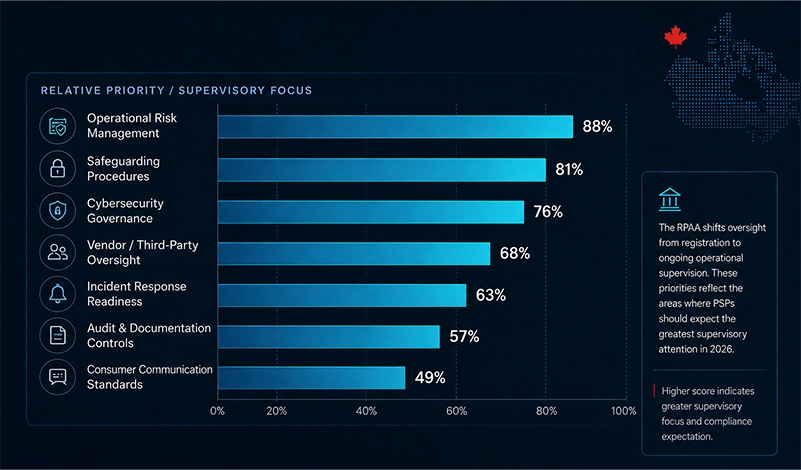
Source:Canadian fintech infrastructure discussions, digital identity modernization initiatives, cybersecurity analysis, verification technology commentary, and public-sector authentication framework reporting.
Conclusion
Canada’s digital identity discussions are no longer sitting entirely outside the payments sector.
As onboarding systems become more complex and fraud risks grow more sophisticated, fintech firms and payment providers are paying closer attention to how identity verification infrastructure could evolve over the next several years.
No unified national model has emerged, and much of the ecosystem remains fragmented, experimental, or still under development. Even so, the direction of discussion inside Canada’s financial technology sector is becoming easier to recognize.
Verification is gradually shifting from a background compliance process into a broader infrastructure question tied to authentication, onboarding efficiency, account security, and transaction confidence.
For payment platforms, that conversation is becoming increasingly difficult to separate from the future of digital access itself.
FAQ
What is CanadaLogin?
CanadaLogin is a government authentication service that allows users to securely access participating federal services using credential partners or sign-in credentials.
What are digital credentials?
Digital credentials are electronic forms of identity verification that can confirm specific information about a user, such as identity attributes or authentication status, within digital systems.
Are reusable digital identity systems already fully implemented in Canada?
No. Canada’s digital identity ecosystem is still developing and remains fragmented across public-sector initiatives, provincial systems, and private-sector technologies.
Why are fintech companies interested in digital credentials?
Many fintech platforms are exploring whether reusable credentials could help reduce onboarding friction, strengthen authentication processes, and improve account verification efficiency.
How does digital identity relate to payments?
Identity verification now plays a major role in onboarding, fraud prevention, account recovery, and transaction trust across digital payment platforms and financial services.
Could digital credentials eliminate fraud completely?
No system removes fraud risk entirely. However, stronger authentication frameworks and modern verification systems may help reduce certain risks associated with account takeovers, credential theft, and identity abuse.