



Canada’s digital payment ecosystem has spent years focused on speed, convenience, and onboarding innovation. Now, more of the conversation inside the sector is shifting toward something less visible: whether the infrastructure underneath those services can remain consistently available as dependency on digital transactions keeps expanding.
That shift is showing up across banks, fintech firms, payment processors, and infrastructure providers.
Real-time transfers, digital wallets, embedded finance systems, and mobile-first payment experiences have changed how Canadians interact with money day to day. The deeper those systems become integrated into commerce, the more operational continuity starts to matter.
Not because the industry is responding to one defining crisis. If anything, the discussion has become more preventative and infrastructure-oriented.
Uptime planning, outage response coordination, redundancy systems, incident recovery frameworks, and operational resilience testing are all receiving closer attention inside Canada’s evolving payments environment.
In many ways, the sector is entering a phase where reliability itself is becoming part of the product.
Payments Infrastructure Is Becoming Less Visible — and More Critical
One of the defining characteristics of modern payment systems is that consumers rarely think about the infrastructure behind them until something slows down or stops working.
Digital payments have become routine:
- tap-to-pay transactions,
- instant account transfers,
- online purchases,
- wallet-based authentication,
- subscription billing,
- and real-time financial notifications.
The smoother the experience becomes, the more invisible the underlying systems appear.
That invisibility creates a different kind of operational pressure.
Financial institutions and payment providers are now supporting transaction environments where even relatively short disruptions can affect merchants, customer-service operations, onboarding flows, and consumer confidence at the same time.
The result is a growing emphasis on resilience planning that extends beyond traditional cybersecurity discussions.
Operational Resilience Is Expanding Beyond Cybersecurity
For years, operational-risk discussions inside financial services were closely associated with cyber threats and fraud mitigation. Those concerns remain central, but infrastructure resilience conversations are broadening.
The focus now includes:
- service continuity,
- transaction recoverability,
- cloud dependency,
- third-party infrastructure exposure,
- data synchronization,
- system failover,
- and incident coordination across interconnected payment environments.
That evolution reflects how modern payment ecosystems actually operate.
A digital transaction today may involve multiple infrastructure layers functioning simultaneously:
- banking systems,
- payment gateways,
- authentication providers,
- cloud services,
- fraud-screening tools,
- identity-verification systems,
- and merchant platforms.
When one layer experiences operational disruption, the effects can spread outward quickly — even when no security breach has occurred.
Industry discussions are becoming more focused on reducing that operational fragility.
Real-Time Payments Raise Reliability Expectations
Canada’s movement toward faster and more immediate payment experiences is also changing infrastructure expectations.
Consumers who become accustomed to near-instant transactions tend to interpret availability differently than they did in slower banking environments. Delays that may once have been considered manageable now attract more attention from both users and businesses.
That shift is not necessarily unreasonable. It reflects how digital commerce itself has evolved.
Merchants rely on continuous payment availability for online sales. Fintech platforms depend on uninterrupted onboarding and wallet functionality. Consumers expect financial access across evenings, weekends, and non-traditional banking hours.
As payment ecosystems move closer to real-time operational models, infrastructure uptime becomes more commercially significant.
Quietly, operational resilience is becoming tied to customer experience.
Incident Response Planning Is Becoming More Structured
Another noticeable shift across Canada’s payments sector involves incident-response preparation.
Infrastructure operators, financial institutions, and PSPs are placing greater emphasis on how operational incidents are identified, escalated, communicated, and resolved internally.
The emphasis is not only technical. Governance is becoming part of the equation as well.
Firms are reviewing:
- escalation procedures,
- internal communication frameworks,
- outage notification processes,
- third-party coordination,
- recovery timelines,
- operational testing cycles,
- and continuity-planning standards.
Some of these discussions are influenced by evolving supervisory expectations. Others are simply a response to how dependent modern commerce has become on uninterrupted digital financial access.
Either way, operational preparedness is becoming more formalized across the sector.
Redundancy and Infrastructure Diversification Are Drawing Attention
Infrastructure redundancy — once viewed mainly as a back-office engineering concern — is becoming a broader strategic consideration.
Payment platforms are evaluating how concentrated certain operational dependencies have become, particularly around cloud environments, third-party vendors, and integrated service providers.
That does not imply the sector is moving away from centralized infrastructure partnerships. In many cases, shared infrastructure remains operationally efficient and commercially necessary.
Still, firms are asking more detailed continuity questions:
- What happens if a provider experiences downtime?
- How quickly can systems fail over?
- Which services depend on shared infrastructure layers?
- Where are operational bottlenecks concentrated?
- How resilient are recovery processes during high transaction periods?
Inside infrastructure discussions, redundancy is gradually shifting from technical optimization toward operational governance.
Canada’s Financial Infrastructure Is Becoming More Interconnected
The challenge surrounding operational resilience is partly structural.
Canada’s payment ecosystem is becoming more interconnected as banks, fintech providers, verification systems, cloud infrastructure, merchant technologies, and digital identity services interact more closely with one another.
That interconnectedness improves efficiency and expands functionality. It also increases operational coordination requirements.
A disruption in one environment can now affect onboarding systems, authentication flows, payment confirmations, settlement timing, and customer-support operations across multiple organizations simultaneously.
This is one reason resilience discussions are becoming broader than individual company preparedness alone.
The conversation increasingly includes ecosystem coordination.
Table: Key Operational Resilience Priorities Emerging Across Canada’s Payment Ecosystem
|
Infrastructure Area |
Current Industry Focus |
|
Service continuity |
Maintaining transaction availability during disruptions |
|
Incident response |
Faster escalation and operational recovery coordination |
|
Infrastructure redundancy |
Reducing dependency concentration risks |
|
Third-party oversight |
Monitoring operational exposure to vendors |
|
Real-time transaction stability |
Supporting continuous payment availability |
|
Operational testing |
Improving resilience validation and recovery readiness |
|
Communication protocols |
Managing outage reporting and stakeholder coordination |
📊 Operational Resilience Priorities Across Canada’s Digital Payment Infrastructure (2026)
How uptime planning, transaction continuity, and infrastructure coordination are becoming central operational priorities inside Canada’s evolving payments ecosystem.
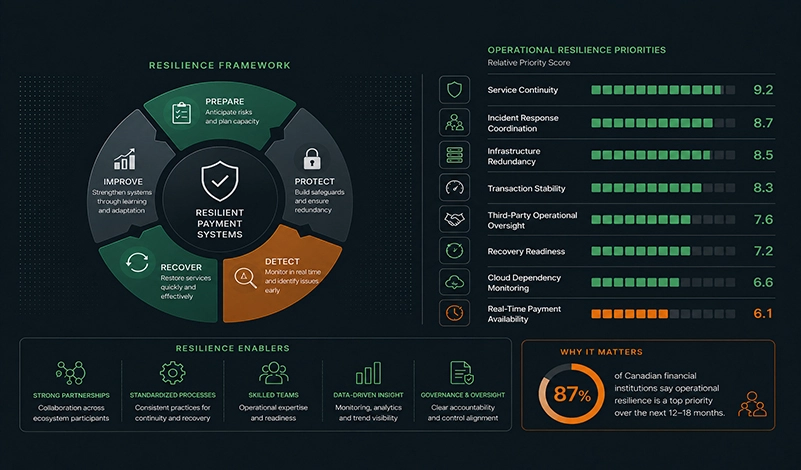
Source: Canadian payment infrastructure discussions, fintech operational-risk analysis, financial-sector continuity planning commentary, payment modernization reporting, and infrastructure governance observations.
Financial Institutions Are Reassessing Operational Dependency
Large financial institutions are also revisiting operational dependency models as digital transaction volumes continue expanding.
Part of that reassessment involves understanding how customer expectations have changed. Another part comes from recognizing how deeply integrated digital payments have become within broader economic activity.
The conversation is no longer limited to banks alone.
Fintech providers, payment facilitators, wallet ecosystems, merchant-service platforms, and infrastructure vendors are all participating in resilience planning discussions in different ways.
There is also growing recognition that resilience is not purely defensive. Reliable infrastructure can strengthen institutional credibility, improve merchant confidence, and reduce operational friction across payment ecosystems.
That perspective is becoming more visible in Canadian fintech discussions.
Conclusion
Operational resilience is moving closer to the centre of Canada’s digital payments conversation.
The shift is not being driven by panic or by a single infrastructure event. It is emerging more naturally from the realities of a payment ecosystem that has become more real-time, more interconnected, and more continuously available.
As digital transactions become embedded more deeply into everyday commerce, expectations around uptime, continuity, and recovery are changing alongside them.
For financial institutions and fintech operators, resilience is becoming less of a technical background issue and more of a strategic infrastructure responsibility.
That evolution is likely to shape future discussions around payment modernization, PSP supervision, identity systems, transaction trust, and financial infrastructure governance across Canada’s broader digital economy.
FAQ
What does operational resilience mean in digital payments?
Operational resilience refers to a payment system’s ability to maintain critical services, recover from disruptions, and continue operating during incidents affecting infrastructure or technology environments.
Why is operational resilience becoming more important in Canada?
Canada’s payment ecosystem is becoming more dependent on digital transactions, real-time transfers, mobile banking, and interconnected fintech infrastructure, increasing the importance of service continuity and uptime planning.
Is operational resilience only about cybersecurity?
No. Cybersecurity remains important, but operational resilience also includes outage recovery, infrastructure redundancy, incident-response coordination, continuity planning, and third-party operational-risk management.
How do real-time payments affect infrastructure expectations?
Faster payment environments tend to raise expectations around continuous availability and rapid recovery when service disruptions occur.
Why are payment providers focusing more on redundancy?
Many firms are reassessing operational dependency risks tied to cloud services, infrastructure concentration, and interconnected third-party systems.
Could operational resilience become part of future financial oversight discussions?
Many industry observers expect operational continuity, recovery planning, and infrastructure governance to remain important topics within Canada’s evolving payment and fintech oversight environment.