


Modern payment systems rarely operate in isolation.
A card payment, an account transfer, a digital wallet transaction, or even a customer verification request may pass through several external services before completion. Many of those services remain invisible to consumers, but they have become deeply embedded in the day-to-day functioning of Canada's financial infrastructure.
That interconnectedness is changing the conversation inside the industry.
Banks, fintech firms, payment processors, and regulators are paying closer attention to third-party dependencies — not because external providers are new, but because the ecosystem itself has become more layered than it was a decade ago.
The discussion is less about individual vendors and more about governance.
Who depends on whom?
Where are operational concentrations emerging?
How visible are those dependencies?
And how should institutions manage risks that sit outside their own walls?
These questions are becoming more common as Canada's payment ecosystem expands.
Payment Services Now Rely on Multiple External Layers
Financial institutions have always relied on specialized partners.
What has changed is the number of interconnected services supporting a single transaction.
Deposits and withdrawals may involve external processors.
Fraud monitoring systems often depend on specialized analytics platforms.
Authentication flows can rely on SMS providers or identity services.
Cloud environments support large portions of digital infrastructure.
Customer onboarding processes frequently incorporate external KYC solutions.
Many organizations also depend on outside vendors for notifications, transaction intelligence, account verification, and operational monitoring.
None of these relationships are unusual.
Taken together, however, they create ecosystems that are far more interconnected than they appear from the outside.
Complexity Is Becoming a Governance Issue
This complexity is attracting growing attention across the Canadian payments sector.
Operational responsibilities no longer stop at organizational boundaries.
Even when institutions maintain strong internal controls, service quality can depend on a broader network of providers operating simultaneously.
As a result, governance discussions increasingly include questions surrounding:
- dependency visibility
- vendor oversight
- concentration exposure
- continuity responsibilities
- operational coordination
- escalation procedures
- service availability expectations
Industry observers note that dependency management is gradually becoming less of a procurement issue and more of an operational governance issue.
The distinction matters.
Managing a supplier relationship is one thing.
Understanding how multiple dependencies interact across a payment ecosystem is something else entirely.
Concentration Risk Is Drawing More Attention
Another area receiving closer scrutiny is concentration risk.
Certain infrastructure providers support services used by large portions of the industry. That is not automatically a problem. Shared infrastructure often delivers efficiency, scalability, and consistency.
But concentration naturally raises governance questions.
If multiple institutions rely on similar providers, dependencies can become more connected than they initially appear.
A single service interruption or operational issue may affect numerous organizations at the same time, even when those organizations remain fully operational internally.
That reality is encouraging institutions to map dependencies more carefully and understand where critical service concentrations exist.
Resilience discussions are now extending beyond individual organizations and toward ecosystem awareness.
Dependency Mapping Is Becoming More Common
One noticeable development is the growing importance of dependency mapping.
Organizations are paying closer attention to:
- which providers support critical functions
- how services interact with one another
- where overlapping dependencies exist
- how communication responsibilities are defined
- which relationships are operationally significant
The objective is not to eliminate external providers.
Modern payment ecosystems would be difficult to operate without them.
Instead, institutions are seeking clearer visibility into the connections that already exist.
Dependency mapping is becoming part of infrastructure governance itself.
Interconnected Services Create Shared Responsibilities
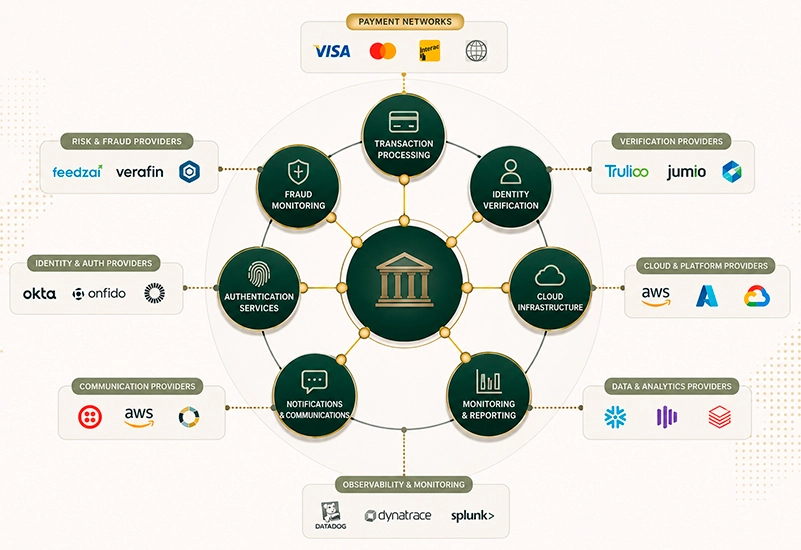
The evolution of Canada's digital payment ecosystem has encouraged closer relationships between banks, fintech firms, cloud vendors, identity providers, payment processors, and analytics companies.
These relationships bring advantages.
Innovation can move faster.
Specialized expertise becomes easier to access.
Services can scale more efficiently.
But interconnected systems also create shared responsibilities.
Service continuity, communications, operational coordination, and accountability increasingly involve multiple participants rather than a single organization.
This dynamic is becoming more visible across discussions surrounding PSP oversight, operational resilience, identity infrastructure, fraud monitoring, and outage accountability.
Different topics.
Same underlying issue.
Modern payment ecosystems are becoming ecosystems in the truest sense of the word.
Governance Expectations Continue To Expand
Vendor oversight itself is nothing new.
What is changing is the breadth of governance expectations surrounding those relationships.
Institutions are placing greater emphasis on:
- operational transparency
- continuity expectations
- escalation frameworks
- dependency documentation
- service-level accountability
- risk visibility
- communication processes
This means governance is extending beyond internal systems.
The perimeter is expanding.
And as digital payments become more interconnected, so do the responsibilities associated with keeping those systems functioning effectively.
Table: Critical Areas of Third-Party Dependency Across Canada's Payment Ecosystem
|
Infrastructure Area |
Common External Dependencies |
|
Transaction processing |
Payment service providers and processors |
|
Customer onboarding |
KYC and identity-verification vendors |
|
Fraud monitoring |
Analytics and transaction intelligence platforms |
|
Authentication |
SMS providers and digital identity services |
|
Notifications |
Messaging and communication vendors |
|
Cloud infrastructure |
Hosting and operational platforms |
|
Monitoring and reporting |
External observability and analytics tools |
Financial Institutions Are Looking Beyond Individual Providers
A broader shift is emerging inside governance discussions.
Institutions are becoming less focused on evaluating providers one by one and more focused on understanding how dependencies interact collectively.
That change reflects the reality of modern infrastructure.
Critical services no longer exist as isolated components.
They operate as interconnected layers.
Ecosystem awareness is becoming almost as important as vendor management itself.
The emphasis is shifting toward understanding relationships rather than simply cataloguing suppliers.
📊 Critical Third-Party Dependencies Across Canada's Digital Payments Ecosystem (2026)
Source:
Canadian payment infrastructure discussions, operational governance analysis, fintech ecosystem reporting, vendor-risk commentary, and observations surrounding dependency management practices.
Conclusion
Canada's payment ecosystem is becoming more interconnected with every stage of digital modernization.
External technology providers, identity systems, fraud platforms, cloud services, and transaction processors are now deeply integrated into how financial services operate.
That integration brings efficiency and innovation.
It also brings new governance considerations.
Institutions are paying closer attention to operational dependencies, concentration exposure, and ecosystem visibility — not because external providers represent a new phenomenon, but because the complexity around those relationships keeps building.
The challenge is not dependency itself.
Dependency has always existed.
The challenge is understanding where those dependencies sit, how they interact, and how governance should respond when financial infrastructure becomes more layered.
For Canada's payment sector, third-party dependency is becoming less of a vendor-management topic and more of an infrastructure-governance question.
FAQ
What are third-party dependencies in payment systems?
Third-party dependencies refer to external providers that support functions such as transaction processing, identity verification, fraud monitoring, authentication, cloud infrastructure, and customer communications.
Why are they receiving more attention?
Because modern digital payment ecosystems involve many interconnected services, making operational visibility and governance increasingly important.
Does relying on external providers create problems?
Not necessarily. External providers deliver specialized capabilities and support scalability. The discussion is more about managing complexity than avoiding partnerships.
What is concentration risk?
Concentration risk refers to situations where many institutions rely on the same critical providers, creating shared dependencies across the ecosystem.
What is dependency mapping?
Dependency mapping involves identifying critical relationships between systems, vendors, and operational services in order to improve visibility and governance.
How does this relate to operational resilience?
Operational resilience focuses on maintaining continuity and managing disruptions. Understanding third-party dependencies helps organizations better coordinate, communicate, and manage continuity across interconnected environments.