

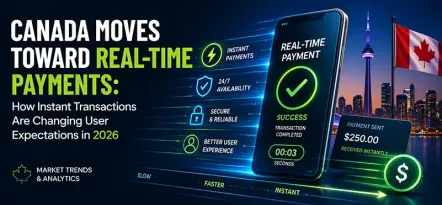
In Canada’s digital economy, expectations around payments are changing rapidly. What was once considered “fast” is no longer enough. Increasingly, users expect transactions to happen instantly — without delays, uncertainty, or additional steps.
Real-time payments are emerging as one of the most important developments shaping user behavior in 2026. As infrastructure evolves, speed is no longer a competitive advantage. It is becoming a baseline expectation.
What are real-time payments?
Real-time payments refer to transactions that are processed and completed within seconds, often available 24/7 without traditional banking delays.
In Canada, this shift is closely tied to the development of modern payment infrastructure designed to support faster, more efficient financial interactions.
Unlike traditional bank transfers, which may take hours or even days, real-time systems aim to deliver immediate confirmation and access to funds.
Why instant payments matter now
For users, payment speed is no longer just about convenience. It directly affects:
- trust in digital platforms
- overall user experience
- decision-making when choosing services
- willingness to complete transactions
Recent industry observations suggest that users increasingly associate faster payments with higher reliability and better service quality.
As a result, delays are no longer seen as normal — they are perceived as friction.
Key differences: traditional vs real-time payments
|
Factor |
Traditional payments |
Real-time payments |
|
Processing time |
Minutes to days |
Seconds |
|
Availability |
Limited hours |
24/7 |
|
User experience |
Delayed confirmation |
Instant confirmation |
|
Perceived reliability |
Moderate |
High |
|
User expectations |
Flexible |
Immediate |
📊 User Expectations in Canada: From Delayed to Instant Payments
Share of Canadian users who expect fast or instant processing when using different payment types in 2026.
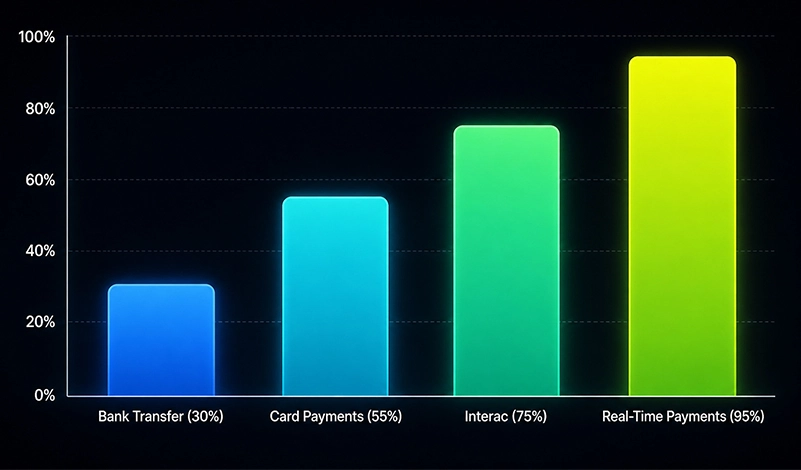
Source: Industry Trends & Analytics Report 2026, based on recent industry observations and aggregated market data across Canadian digital platforms.
How user expectations are shifting
1. Instant access is becoming standard
Users increasingly expect immediate access to funds, not just faster processing.
2. Speed is linked to trust
A fast transaction is often interpreted as a sign of system reliability and platform efficiency.
3. Delays create friction
Even short waiting times can reduce satisfaction and impact user decisions.
Why this shift is happening in 2026
Several factors are driving the move toward real-time payments:
- growing demand for seamless digital experiences
- broader adoption of mobile and online services
- increased competition across digital platforms
- advancements in payment infrastructure
This reflects a broader transformation in digital behavior, where users expect services to be immediate, transparent, and predictable.
How the market is adapting
To meet these expectations, platforms are:
- upgrading payment infrastructure
- reducing processing times
- improving transaction transparency
- focusing on real-time confirmation and feedback
As a result, real-time payments are moving from an innovation to a standard feature.
What to watch next
As real-time systems expand, several developments may shape the market:
- wider adoption across financial services
- increased competition based on speed and reliability
- integration with emerging payment technologies
- rising expectations for full transaction transparency
Conclusion
In 2026, real-time payments are redefining what users expect from digital transactions in Canada.
Speed is no longer just a feature — it is becoming a core component of trust, usability, and overall experience. Platforms that adapt to this shift are more likely to meet evolving user expectations and remain competitive.
FAQ
What are real-time payments?
They are transactions processed instantly, typically within seconds, without delays.
Why are they becoming important in Canada?
Because user expectations around speed and convenience are increasing.
Do real-time payments improve user experience?
Yes, they reduce waiting times and increase transparency.
Are traditional payments becoming outdated?
Not entirely, but they are being re-evaluated against faster alternatives.
What should users pay attention to?
Processing speed, availability, and transparency of transactions.