



Ontario Sets New Standards for a Centralized iGaming Self-Exclusion Program
What Happened
The new standards point toward a more unified self-exclusion system for Ontario’s regulated iGaming environment. Instead of relying only on site-by-site exclusion tools, the framework is built around a centralized model intended to reduce gaps across the market.
In practical terms, the direction is clear: a player who chooses self-exclusion should not have to repeat the same process separately across multiple regulated platforms. That is the core significance of the change. It moves self-exclusion closer to a market-wide protection tool rather than leaving it as a feature handled in isolation by each operator.
The policy direction is also not appearing out of nowhere. Ontario’s 2023–24 annual reporting had already pointed to work on centralized self-exclusion, which makes the April 2026 standards look like a continuation of an existing regulatory path rather than a stand-alone measure.
Why It Matters
This is not just a technical compliance update. It reflects a broader regulatory view that responsible gambling tools need to match the structure of the market itself. Ontario’s regulated iGaming sector is large, competitive, and still evolving. As the market matures, regulators are under more pressure to ensure that consumer protection measures are not only available on paper, but workable in real life.
A centralized self-exclusion model matters because usability is part of protection. A responsible gambling tool only has real value when it is easy to access, easy to understand, and difficult to bypass during impulsive moments. That is why this change stands out. It focuses not just on policy language, but on how the tool may function across the full regulated ecosystem.
What This Means for Players
For readers, the practical value of this update is straightforward. A more centralized approach could make self-exclusion easier to use and harder to avoid in a multi-operator market.
Key takeaways for players
- self-exclusion is being treated as a market-wide protection issue, not only a site-level feature
- the process is expected to become more visible and easier to access
- fewer procedural gaps may exist across participating regulated operators
- the overall direction strengthens Ontario’s responsible gambling framework
Key Facts at a Glance
|
Regulatory Change |
Practical Effect |
Why It Matters |
|
New AGCO standards for centralized self-exclusion |
Supports a more unified exclusion process |
Reduces fragmentation across the regulated market |
|
Market-wide direction instead of isolated site tools |
Players may face fewer gaps between operators |
Protection tools become more realistic in a competitive market |
|
Greater focus on accessibility and visibility |
Easier discovery and use of self-exclusion options |
Improves the practical value of responsible gambling measures |
|
Continued development of Ontario’s regulated framework |
Stronger alignment between market growth and player safeguards |
Helps reinforce trust in the legal iGaming model |
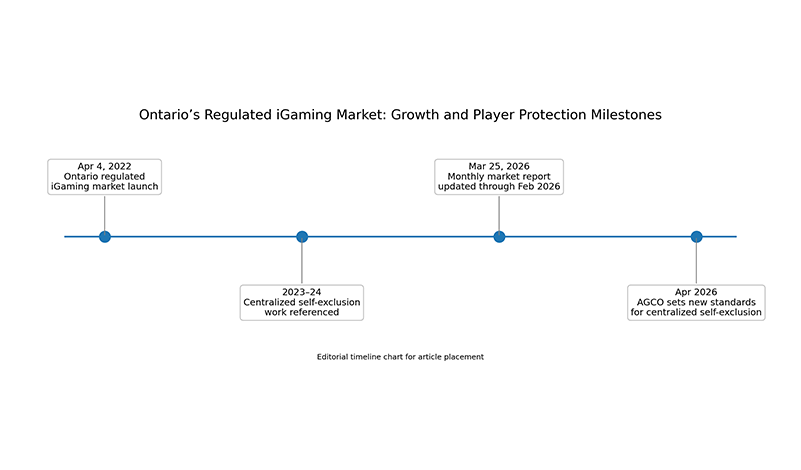
Ontario’s Regulated iGaming Market: Growth and Player Protection Milestones
Background
The announcement fits into a wider regulatory path rather than appearing in isolation. Ontario’s regulated iGaming market launched on April 4, 2022, and expanded quickly into a large multi-operator environment. As that market matured, the case for stronger market-wide player protection tools became harder to ignore.
That is the key background point. A larger legal market creates more consumer choice, but it also raises the bar for oversight. The more brands operate within the same regulated ecosystem, the more important it becomes for responsible gambling tools to work consistently across it. A centralized self-exclusion framework addresses that gap more directly than a fragmented site-by-site model.
The move also aligns with how Ontario has positioned its legal iGaming structure more broadly: not only as a competitive commercial market, but as one built around oversight, fairness, and consumer protection. In that context, stronger self-exclusion standards are not just operational. They are part of how the market defines credibility.
FAQ
What is centralized self-exclusion in iGaming?
It is a framework designed to let a player restrict access across a broader regulated market instead of relying only on separate exclusions at individual sites.
Why is this especially important in Ontario?
Ontario has a large regulated iGaming market with many operators, so a fragmented exclusion process can be less practical for players trying to step away across multiple brands.
What has changed now, exactly?
The key change is that Ontario has set standards pointing toward a more centralized self-exclusion model, strengthening the regulatory direction even though the practical rollout still depends on implementation.
Will this automatically apply to every gambling site in Canada?
No. This development is specific to Ontario’s regulated iGaming market and should not be treated as a Canada-wide rule.
What should readers watch next?
The main issue is rollout: how registration will work in practice, how visible the tool becomes across operators, and how broadly the centralized process is applied within the regulated market.