



Ontario’s regulated iGaming market was built to give players more choice without weakening the protections behind that choice. That is the clearest difference between regulated and unlicensed sites. Both may look polished on the surface, but the real player experience is shaped by oversight, standards, complaint pathways, and the rules operators are required to follow. Ontario’s regulated competitive market launched on April 4, 2022, and iGaming Ontario says its operator directory was accurate as of April 9, 2026, with 48 operators and 82 gaming websites listed.
What “regulated” means in Ontario
In Ontario, a site is part of the regulated market when it is offered by an operator that is registered with the AGCO and has an operating agreement with iGaming Ontario, except for OLG.ca, which operates under its own model. iGaming Ontario presents this as the safer choice for players and maintains a public directory of sites offered by regulated operators. That matters because the label is not just branding. It signals that the operator is inside Ontario’s formal oversight structure.
Why that matters for players
The practical advantage of a regulated market is not abstract. It shows up in the protections around fairness, integrity, account controls, and responsible gambling. AGCO says companies entering Ontario’s market must meet standards for game and operator integrity, fairness, player protections, and responsible gambling. In other words, player protection is part of the market model itself, not an optional extra.
Key takeaways for players
- regulated sites in Ontario sit inside a defined oversight framework
- approved operators must meet standards tied to integrity, fairness, and responsible gambling
- players have a clearer path to identify which sites are part of the legal market
- market-wide protection tools are continuing to evolve, including centralized self-exclusion standards announced in April 2026
How regulated sites can offer stronger player protection
One of the clearest strengths of a regulated market is visibility. Ontario players do not have to guess blindly which sites are inside the approved system, because iGaming Ontario publishes a public directory. That alone is useful. It helps separate regulated options from sites operating outside Ontario’s formal structure. Regulated operators are also connected to a market built around standards and accountability, while unlicensed sites do not carry the same Ontario-specific framework.
Another advantage is responsible gambling infrastructure. In April 2026, AGCO announced standards for a centralized self-exclusion program intended to let players voluntarily exclude themselves from all regulated iGaming sites in Ontario through one streamlined process. That is important because it shows Ontario moving toward stronger market-wide safeguards rather than relying only on isolated site-by-site tools.
Regulated vs. unlicensed: what changes in practice
|
Area |
Regulated Ontario market |
Unlicensed sites |
|
Market status |
Inside Ontario’s approved framework |
Outside Ontario’s regulated framework |
|
Public market visibility |
Listed in iGaming Ontario’s public directory |
May be harder for players to verify through Ontario channels |
|
Protection framework |
Built around standards, oversight, and responsible gambling requirements |
Not part of Ontario’s formal protection structure |
|
Self-exclusion access |
Moving toward centralized market-wide exclusion |
No Ontario-wide centralized framework |
|
Complaint clarity |
Clearer regulatory context for players |
Less clarity from an Ontario regulatory standpoint |
The table does not mean every regulated site is identical or that every unlicensed site operates the same way. The point is narrower and more practical: Ontario’s regulated market gives players a more structured protection environment. That structure matters most when a player needs support, wants clearer rules, or needs tools that are easier to trust and use.
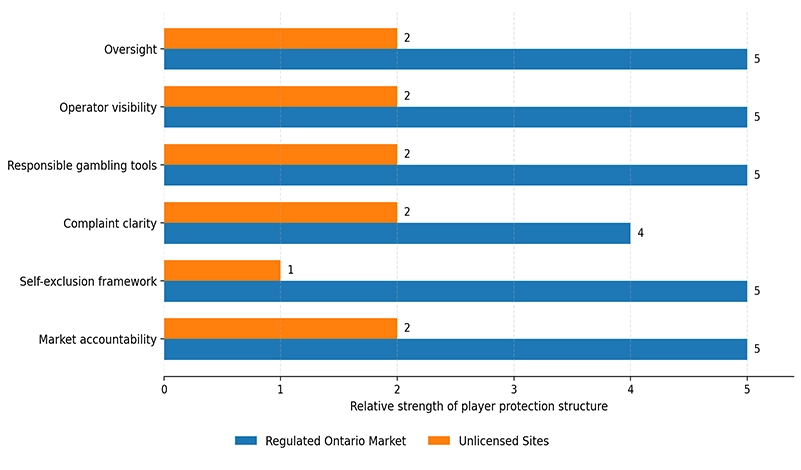
Regulated vs. Unlicensed: Key Player Protection Differences in Ontario
Why this matters even more in a growing market
Ontario’s market is no longer a small pilot. iGaming Ontario’s 2024–25 annual report says the regulated market finished its third year with 50 active operators, more than $82.7 billion in total wagers, more than $2.9 billion in gaming revenue, and over 2.6 million active player accounts. In a market of that size, player protection stops being a side topic and becomes part of market credibility itself.
There is another useful signal in the 2023–24 annual report: iGaming Ontario said a joint AGCO-iGO study found that 86.4% of Ontario players reported playing on a regulated site between January and March 2024. That does not eliminate risk, but it suggests the legal market has gained real traction with players. A higher share of players inside the regulated system makes protection standards more meaningful at scale.
How players can use this information
For readers, the most practical lesson is not to memorize regulatory language. It is to understand what to check before registering or depositing. A player comparing sites should first verify whether the site appears in Ontario’s regulated market directory, then look at whether the operator is clearly positioned inside the province’s approved framework. That is a more reliable first step than judging a site by bonuses, design, or brand familiarity alone.
Quick checklist
- check whether the site appears in iGaming Ontario’s public directory
- confirm the operator is part of Ontario’s regulated market
- look for responsible gambling and account control tools
- treat broad “licensed” claims cautiously if they are not tied to Ontario’s actual framework
- give more weight to oversight and protection tools than to promotions or design
Conclusion
Ontario’s regulated iGaming market protects players better than unlicensed sites because it offers more than access to games. It offers a defined oversight structure, approved operators, public visibility, responsible gambling standards, and a market model that continues to evolve as protection gaps are identified. For players, that does not mean a risk-free experience. It means a clearer, more accountable, and more supportable environment than playing outside Ontario’s regulated framework.
FAQ
How can I tell if a site is regulated in Ontario?
The simplest starting point is iGaming Ontario’s public directory of regulated sites. If the site appears there, it is part of Ontario’s regulated market.
Why are regulated sites safer for players?
Because Ontario’s regulated market is built around standards for integrity, fairness, responsible gambling, and formal oversight.
Does regulated mean risk-free?
No. Regulated does not remove all risk. It means the player is operating inside a more structured and accountable environment.
What is one major advantage regulated sites have over unlicensed sites?
A major advantage is access to a clearer player protection framework, including Ontario’s move toward centralized self-exclusion across regulated sites.
Why does this topic matter more now?
Because Ontario’s market is large, active, and still growing, which makes reliable player protection more important, not less.