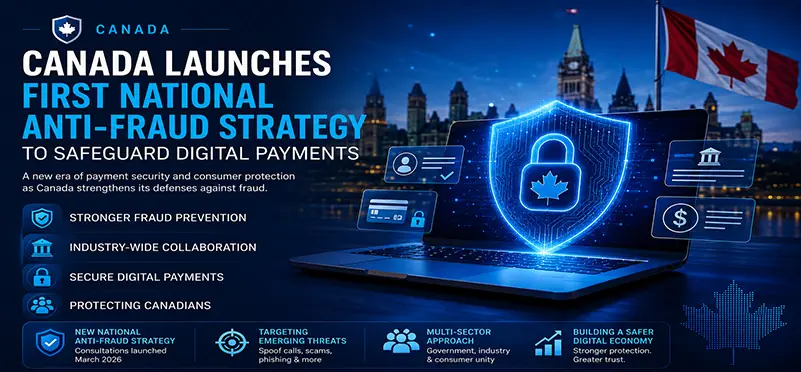



Canada’s payment security landscape is entering a major new phase in 2026 as Ottawa moves forward with the country’s first-ever National Anti-Fraud Strategy. The initiative comes amid growing concern over digital scams, payment fraud, spoofed communications, and financial crimes affecting Canadian consumers and online services.
In late March 2026, Finance Minister François-Philippe Champagne announced national consultations aimed at developing a coordinated anti-fraud framework designed to improve digital payment security and strengthen public trust across Canada’s financial ecosystem.
The strategy reflects a broader shift in how Canada is approaching fraud prevention as digital payments, instant transactions, and online financial services continue to expand.
For Canadian users, this matters because payment security is increasingly becoming part of how digital platforms are evaluated — alongside speed, reliability, and user experience.
What is Canada’s National Anti-Fraud Strategy?
The National Anti-Fraud Strategy is Canada’s first coordinated federal initiative focused specifically on reducing financial scams and improving digital transaction security across multiple industries.
The consultations launched in March 2026 are designed to gather feedback from:
- financial institutions
- telecom providers
- payment companies
- digital platforms
- cybersecurity experts
- consumer protection organizations
The strategy is expected to create a more unified approach to fraud prevention across Canada’s evolving digital economy.
Why this matters now
Canadian authorities say fraud-related threats have become significantly more sophisticated in recent years.
According to federal statements released during the consultations, Canadians lost hundreds of millions of dollars to scams and fraudulent schemes in 2025 alone, with many incidents believed to go unreported.
Government officials highlighted concerns involving:
- spoofed calls and fake messages
- phishing emails
- fraudulent payment requests
- impersonation scams
- online financial manipulation
As digital payments continue moving toward faster and more real-time systems, authorities are placing increased focus on strengthening consumer protections before risks expand further.
Key areas targeted by the strategy
|
Area |
Focus in 2026 |
|
Payment fraud |
Improved monitoring and suspicious activity detection |
|
Scam prevention |
Greater coordination between sectors |
|
Digital communications |
Reducing spoofed calls and fake messages |
|
Consumer awareness |
Expanding public fraud education |
|
Financial security |
Building stronger trust in digital transactions |
📊 Fraud Prevention Priorities in Canada’s Digital Payment Ecosystem (2026)
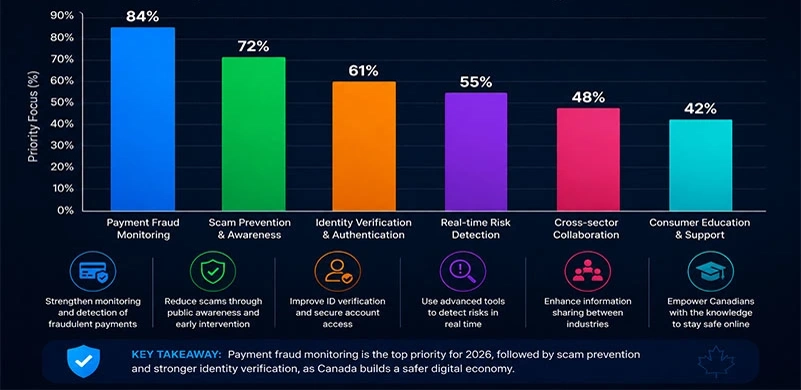
Priority focus areas identified in Canada’s National Anti-Fraud Strategy consultations, highlighting the growing importance of payment fraud monitoring, scam prevention, identity verification, and real-time risk detection across Canada’s digital economy.
How the strategy could affect digital payments
The proposed framework may introduce stronger expectations for banks, payment providers, and digital platforms operating in Canada.
Potential measures discussed during consultations include:
- enhanced fraud monitoring systems
- stronger identity verification processes
- improved transaction risk detection
- additional safeguards for high-risk transfers
- faster reporting and coordination between institutions
The broader goal is to improve security without significantly reducing payment convenience or speed.
Why payment security is becoming more important in 2026
Canada’s digital payment environment is evolving rapidly.
Recent developments involving real-time payment infrastructure, instant transaction expectations, and broader online financial activity have increased the importance of fraud prevention systems.
For users, trust is no longer based only on payment speed. Increasingly, it also depends on:
- transparency
- account protection
- transaction monitoring
- confidence in digital systems
This shift is changing how financial platforms and digital services are evaluated across Canada.
Government and industry response
Federal officials described fraud as a growing threat to both financial security and public trust.
The consultations are expected to contribute to a broader multi-sector framework involving cooperation between government agencies, financial institutions, telecom providers, and digital platforms.
The anti-fraud initiative also aligns with other recent measures discussed in Canada’s 2026 financial and regulatory agenda, including stronger financial crime enforcement and expanded oversight of emerging digital payment risks.
What happens next
The consultation period is expected to help shape the final direction of Canada’s anti-fraud framework throughout 2026.
Possible next steps may include:
- updated fraud prevention standards
- additional regulatory guidance
- stronger reporting requirements
- expanded coordination between sectors
- new consumer protection measures
As Canada continues modernizing its payment infrastructure, fraud prevention is likely to remain one of the central priorities shaping the country’s digital financial environment.
Conclusion
Canada’s first National Anti-Fraud Strategy marks an important step in the country’s broader effort to strengthen digital payment security and protect consumers from evolving financial scams.
As online payments become faster and more integrated into everyday life, regulators and industry participants are placing greater emphasis on trust, verification, and fraud prevention.
For Canadian users, the strategy represents a wider shift toward safer and more closely monitored digital transactions in 2026.
FAQ
What is Canada’s National Anti-Fraud Strategy?
It is a federal initiative launched in 2026 aimed at improving fraud prevention and digital payment security across Canada.
Why was the strategy introduced?
The government says rising fraud losses and increasingly sophisticated scams created the need for a more coordinated national approach.
Will this affect digital payments?
The strategy may lead to stronger fraud monitoring, improved verification systems, and additional safeguards for digital transactions.
Does this relate to real-time payments?
Yes. As instant payment systems expand, fraud prevention is becoming more important across Canada’s payment ecosystem.
What industries are involved?
The consultations involve financial institutions, telecom companies, payment providers, digital platforms, and consumer protection groups.