

Speed has dominated much of the conversation around Canada's payment modernization efforts. Reliability, meanwhile, spent years operating quietly in the background.
That balance is starting to change.
As digital wallets, instant transfers, online banking platforms, and embedded financial services become more deeply woven into everyday life, service interruptions are attracting greater scrutiny from institutions, regulators, businesses, and consumers alike.
The conversation itself is evolving.
Outages are not new. Complex financial systems have always experienced disruptions, maintenance events, and unexpected operational issues. What is changing is how those events are viewed once they occur.
Across Canada's digital finance ecosystem, expectations around accountability, communication, recovery coordination, and transparency are receiving greater attention. Reliability is now being judged not only by whether disruptions happen, but also by how institutions respond when they do.
The result is a stronger focus on what many industry observers describe as the human side of infrastructure: keeping customers informed, coordinating recovery efforts, and maintaining confidence during periods of disruption.
Digital Dependence Is Changing Expectations
Consumer expectations around financial services have evolved quickly.
Payments no longer happen primarily during banking hours. Canadians now move money, pay bills, manage subscriptions, shop online, and access digital wallets throughout the day.
That shift has created a different relationship with availability.
For many consumers, payments have become an always-on service. Businesses, merchants, and fintech platforms operate with similar assumptions.
As a result, even relatively short disruptions can affect multiple layers of activity simultaneously.
Transactions may be delayed.
Authentication flows can be interrupted.
Merchant operations may slow down.
Customer support channels often experience immediate pressure.
The growing dependency on digital finance means outages are increasingly viewed through a customer experience lens rather than simply as technical events.
Attention Is Moving Beyond Root Causes
Operational resilience discussions often focus on reducing the likelihood of disruptions.
But another set of questions is receiving more attention across the industry.
How quickly are customers notified?
Are updates clear and consistent?
How are partners informed?
How is recovery coordinated across interconnected systems?
What information becomes available after service is restored?
These questions have become increasingly important because payment ecosystems are highly interconnected.
A disruption affecting one organization may ripple into merchant services, authentication providers, fraud systems, wallet platforms, and customer support environments elsewhere.
Consequently, response quality itself is becoming part of infrastructure performance.
Communication Is Becoming Part of Service Reliability
Historically, outage communications were often treated as secondary to technical recovery.
That approach is changing.
Financial institutions and payment providers are placing greater emphasis on customer notifications, status updates, and communication protocols during service interruptions.
Clear messaging can reduce uncertainty even when recovery requires time.
Consumers generally understand that technical incidents occur. Frustration tends to rise when information becomes difficult to obtain or when updates appear inconsistent.
This has encouraged many organizations to strengthen coordination between technology teams, operations groups, communications departments, and customer-service functions.
The objective is straightforward.
Recovery matters.
Visibility matters too.
Recovery Coordination Is Becoming More Complex
Modern payment ecosystems rely on multiple participants operating simultaneously.
Banks.
Payment processors.
Cloud providers.
Fraud-monitoring tools.
Merchant platforms.
Third-party vendors.
Because of this complexity, recovery is rarely confined to a single team.
Coordinating restoration efforts often requires communication across organizations with different technologies, priorities, and operational responsibilities.
Industry discussions increasingly recognize that downtime events are not only technical exercises. They are coordination exercises as well.
The ability to restore service efficiently depends as much on collaboration as on infrastructure itself.
Real-Time Payments Raise Availability Expectations
Faster payment environments naturally change customer expectations.
As settlement speeds improve and transaction processing becomes more immediate, interruptions become more visible.
Consumers who experience near-instant transactions on most days may perceive delays differently than they did in traditional banking environments.
Businesses face similar pressures.
Merchants depend on transaction continuity.
Subscription platforms rely on uninterrupted payment flows.
Fintech applications increasingly support services expected to function continuously.
This does not mean expectations are unrealistic.
Rather, payment modernization and availability expectations are evolving together.
The two are becoming increasingly difficult to separate.
Accountability Is Becoming a Governance Issue
Another notable shift involves governance.
Reliability discussions are extending beyond technology teams.
Executives, compliance officers, operational-risk specialists, and regulators are all taking a more active role in outage accountability conversations.
The emphasis is less about assigning blame and more about clarifying responsibilities.
Questions increasingly include:
- Were escalation procedures effective?
- Were customers informed promptly?
- How were third-party dependencies managed?
- Did recovery processes function as intended?
- Were lessons incorporated into future planning?
These discussions align with broader developments across Canada's financial infrastructure ecosystem, where operational governance is becoming more visible alongside payment modernization initiatives.
Table: Areas Receiving Greater Attention During Payment Disruptions
|
Area |
Current Industry Focus |
|
Customer notifications |
Faster and clearer communication |
|
Recovery coordination |
Cross-functional response management |
|
Status transparency |
Timely service updates |
|
Third-party dependencies |
Shared operational awareness |
|
Defined response procedures |
|
|
Post-event reviews |
Continuous improvement processes |
|
Service reliability metrics |
Availability expectations and reporting |
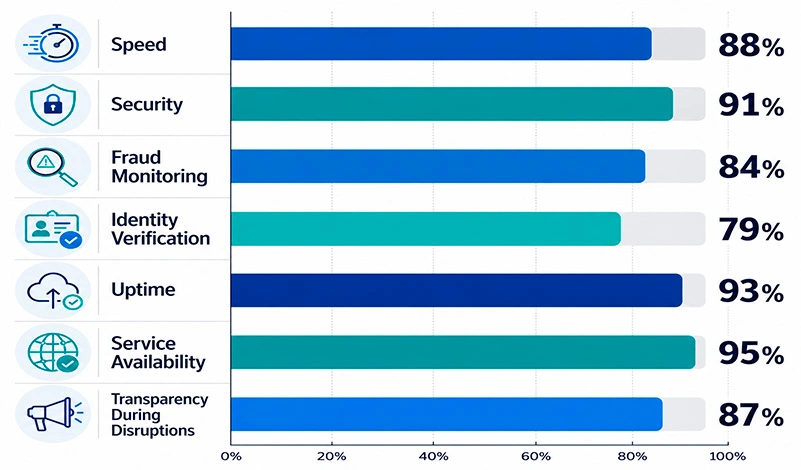
📊 Rising Expectations Around Digital Payment Reliability
Illustrative values showing the relative importance of key factors shaping expectations around digital payment reliability across Canada's evolving financial ecosystem.
Source:
Illustrative editorial model based on Canadian digital payment infrastructure discussions and evolving consumer expectations. Values are provided for visualization purposes and are not derived from a specific survey.
Reliability Is Becoming Part of Competitive Trust
Speed and innovation remain important.
But reliability increasingly influences reputation.
Consumers may not understand the technical architecture supporting a payment system. What they remember is whether services remained available and how organizations communicated when problems occurred.
That dynamic is becoming more important for banks, fintech providers, payment processors, and digital platforms alike.
Reliability, once viewed mainly as an operational requirement, is gradually becoming part of institutional trust.
Not because outages can be eliminated entirely.
Complex systems do not work that way.
But because accountability expectations continue to rise alongside digital dependence.
Conclusion
Canada's digital finance ecosystem is becoming more dependent on continuous availability.
That reality is changing how service disruptions are viewed.
The discussion is moving beyond the question of whether outages can occur. Complex infrastructures will always face operational challenges.
Attention is shifting elsewhere.
Communication.
Coordination.
Transparency.
Recovery.
Those themes are becoming more prominent as digital payments, real-time transactions, identity systems, and fraud-monitoring infrastructure grow more interconnected.
In many respects, the next chapter of payment modernization may not be defined solely by how quickly money moves.
It may also be shaped by how effectively institutions respond when interruptions occur.
Because in an always-connected financial environment, reliability itself is becoming part of the service.
FAQ
Are payment outages becoming more common in Canada?
The industry focus is less on whether outages are increasing and more on how dependence on digital services has made disruptions more visible and operationally significant.
Why are institutions paying more attention to outage accountability?
As financial services become increasingly digital, customer expectations around communication, recovery, and transparency are also rising.
What is recovery coordination?
Recovery coordination refers to the processes and collaboration required between multiple teams and organizations to restore services after an interruption.
Why are customer notifications becoming more important?
Clear communication helps reduce uncertainty and allows consumers and businesses to understand the status of services during disruptions.
How does this relate to real-time payments?
Faster transaction environments tend to raise expectations around continuous availability, making service interruptions more noticeable.
Can payment systems eliminate outages entirely?
No. Complex infrastructures cannot completely eliminate disruptions. Industry efforts are increasingly focused on resilience, accountability, and effective recovery processes.