

When players compare online casinos, one of the first things they often notice is the rating score. A casino rated 9.5/10 may appear significantly stronger than one rated 8.5/10, but what do those numbers actually mean?
At 1000themes, ratings are not based on advertising, popularity, or marketing claims. We use a consistent evaluation process designed to help Canadian players understand the strengths and weaknesses of each casino.
This guide explains how our ratings are created, which factors matter most, and why transparency is an essential part of every review we publish.
Why Casino Ratings Matter
Online casinos can look very similar at first glance. Many offer welcome bonuses, hundreds of games, mobile apps, and multiple payment methods.
Ratings help simplify comparisons by evaluating the areas that genuinely affect the player experience.
A good rating system should help answer questions such as:
- Is the casino properly licensed?
- Are payments reliable?
- Are bonus terms fair?
- Is customer support responsive?
- Does the casino provide responsible gambling tools?
Without a structured methodology, players are often left comparing marketing promises rather than meaningful differences.
Transparency is important because readers should understand not only a casino's score, but also how that score was earned.
Our Casino Review Process
Every casino review follows the same structured process.
- Licensing Verification
- Security Review
- Bonus Evaluation
- Payment Analysis
- Game Selection Review
- Customer Support Assessment
- Mobile Experience Testing
- Responsible Gambling Review
Each category contributes to the overall score.
This approach helps ensure consistency across reviews and allows casinos to be compared using the same standards.
A casino with excellent bonuses but weak security should not receive a high rating simply because its promotions look attractive. Likewise, a casino with fast payments but poor customer support may lose points in other areas.
Licensing is the foundation of every casino review because it directly affects player protection, dispute resolution procedures, operational transparency, and regulatory oversight.
During our review process, we verify whether a casino operates under recognized regulatory frameworks and whether licensing information is clearly disclosed to players.
Strong regulatory oversight generally requires casinos to follow standards related to fair gaming practices, responsible gambling measures, financial transparency, and player fund protection.
A casino may offer attractive bonuses and hundreds of games, but weak licensing can significantly reduce its overall rating because trust and player safety remain our highest priorities.
The Factors We Evaluate
|
Factor |
Importance |
What We Review |
|
Licensing |
Very High |
Regulatory oversight, reputation, transparency |
|
Security |
Very High |
Encryption, data protection, account safety |
|
Payments |
High |
Deposit options, withdrawal speed, reliability |
|
Bonuses |
High |
Fairness, value, wagering requirements |
|
Games |
Medium |
Variety, providers, RTP availability |
|
Support |
Medium |
Response speed, availability, helpfulness |
|
Mobile Experience |
Medium |
Usability across devices |
|
Responsible Gambling |
Important |
Limits, self-exclusion tools, player protection |
Security receives one of the highest weightings in our methodology because players trust casinos with personal information, financial details, and account balances.
During our reviews, we examine factors such as:
- SSL encryption
- secure payment processing
- account verification procedures
- password and account protection measures
- privacy practices
- overall platform transparency
While most reputable casinos implement modern security standards, differences in transparency and player protection policies can still influence final scores.
Factors That Influence Our Casino Ratings
Not every review category contributes equally to the final score.
Some factors directly affect player safety and trust, while others primarily influence convenience and overall user experience.
For this reason, licensing and security receive the highest weighting in our methodology. Features such as bonuses and game selection remain important, but they cannot compensate for weaknesses in player protection or platform reliability.
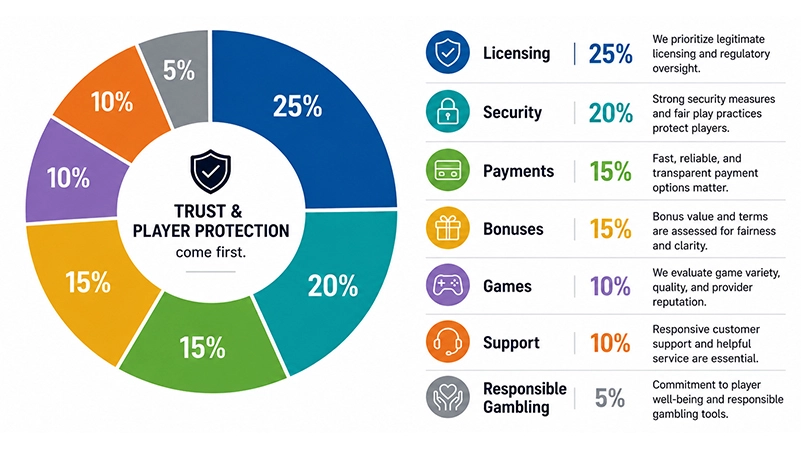
The table below illustrates how different categories contribute to our overall rating framework.
|
Category |
Approximate Weight |
|
Licensing |
25% |
|
Security |
20% |
|
Payments |
15% |
|
Bonuses |
15% |
|
Games |
10% |
|
Support |
10% |
|
Responsible Gambling |
5% |
Factors That Influence Our Casino Ratings
This infographic explains the methodology behind our casino rating system. While multiple factors contribute to a casino's overall score, the greatest weight is assigned to licensing, security, and player protection. Bonuses, game selection, payment options, customer support, and responsible gambling tools are also evaluated, but strong promotional offers cannot compensate for weak regulatory oversight or inadequate security standards.
Source:1000themes Editorial Methodology and Casino Review Framework (2026). Based on the weighted evaluation criteria used to assess online casinos for Canadian players.
How Rating Factors Work Together
One useful way to view casino ratings is that some factors protect players, while others improve the overall experience.
Licensing and security form the foundation of trust.
Payments, bonuses, and customer support directly affect day-to-day usability.
Game selection and mobile performance help determine how enjoyable and convenient the platform feels over time.
A casino that performs consistently well across all categories will generally rank higher than one that excels in only a single area.
How We Evaluate Bonuses
Bonuses are often among the most heavily advertised features of any casino.
However, large bonus amounts do not automatically result in higher ratings.
We evaluate:
- wagering requirements
- maximum withdrawal limits
- maximum bet restrictions
- bonus expiry periods
- game contribution rules
- overall promotional value
Consider the following example:
- Casino A offers a CA$1,000 bonus with 50x wagering requirements.
- Casino B offers a CA$500 bonus with 20x wagering requirements.
Although the first promotion appears larger, the second may offer better practical value because players face fewer wagering obligations before becoming eligible for withdrawals.
This is why our reviews focus on real-world bonus value rather than promotional headline numbers alone.
A CA$1,000 bonus with extremely restrictive conditions may provide less real value than a smaller offer with more reasonable terms.
Our goal is to assess what players actually receive rather than focusing on headline marketing numbers.
This evaluation process closely aligns with the concepts discussed in our guide on understanding casino bonus terms.
How We Evaluate Payments
Reliable banking options are a critical part of the player experience.
When reviewing payments, we consider:
- deposit speed
- withdrawal speed
- payment method variety
- transaction reliability
- fee transparency
- availability for Canadian players
Fast withdrawals can significantly improve the user experience, while recurring delays often reduce a casino's rating.
We also consider whether casinos support popular Canadian payment methods and whether payment information is presented clearly.
This area naturally connects with our guides on payment methods and casino deposits and withdrawals.
How RTP and Volatility Influence Ratings
Game quality is about more than simply counting how many titles a casino offers.
We also examine information related to RTP (Return to Player), game transparency, and overall game variety.
Higher RTP games generally provide stronger long-term value, although RTP alone never determines a casino's ranking.
Volatility is also important because it influences the player experience.
Two casinos may offer similar game libraries, but differences in providers and game selection can create very different experiences for players seeking low, medium, or high-volatility games.
For that reason, RTP and volatility are evaluated within the broader context of game quality rather than as isolated metrics.
What Can Lower a Casino's Rating?
Several issues can reduce a casino's overall score.
Common examples include:
- weak or unclear licensing
- poor security practices
- misleading bonus terms
- excessive wagering requirements
- slow withdrawals
- limited payment options
- poor customer support
- outdated mobile experience
- lack of responsible gambling tools
Even one major weakness can significantly affect a rating if it impacts player safety or trust.
Why Ratings Can Change Over Time
Casino ratings are not permanent.
Online casinos regularly update their platforms, payment systems, promotional policies, and player protection features. As a result, a casino that performs well today may improve further—or decline—in the future.
Several factors can influence rating changes over time:
- faster or slower withdrawal processing
- updates to bonus terms
- changes in customer support quality
- new payment methods
- improvements to mobile platforms
- enhanced responsible gambling tools
- security upgrades
- licensing or regulatory developments
For example, a casino that introduces faster withdrawals and stronger player protection tools may earn a higher rating during future reviews.
Likewise, a casino that begins using less transparent bonus terms or develops recurring payment delays may lose points.
Periodic reviews help ensure ratings reflect the current player experience rather than historical performance.
Our goal is not simply to assign a score once, but to maintain a methodology that adapts as casinos evolve. This helps readers make decisions based on current information and supports greater transparency across the review process.
Do Casinos Pay for Better Ratings?
No.
A casino cannot purchase a higher score on 1000themes.
Advertising partnerships, affiliate relationships, and commercial agreements do not determine ratings.
Maintaining editorial independence is one of the most important principles behind our review process.
A casino's rating is determined exclusively by its performance within our evaluation criteria. Commercial relationships do not increase scores, remove weaknesses, or influence the methodology applied during reviews.
Consistency is essential because trust can only exist when the same standards are applied to every casino.
This separation is important because ratings are intended to help readers make informed decisions, not to promote specific operators.
A casino can improve its rating only by performing well against the evaluation criteria.
Transparency and consistency are essential to maintaining editorial credibility and reader trust.
How Players Can Use Casino Ratings
Ratings should be viewed as a research tool rather than a final decision.
A rating helps summarize a casino's strengths and weaknesses, making meaningful comparisons easier.
Players can use ratings to:
- compare multiple casinos
- identify potential concerns
- evaluate bonus quality
- assess payment reliability
- understand security standards
- support their own research
The best approach is to combine ratings with personal preferences, budget considerations, and responsible gambling habits.
No single score can perfectly reflect every player's priorities, but a transparent methodology can provide a useful starting point.
Conclusion
Casino ratings are most useful when players understand how they are created.
At 1000themes, ratings are based on a structured methodology that evaluates licensing, security, payments, bonuses, games, customer support, mobile experience, and responsible gambling features. The goal is not simply to assign a number, but to provide a consistent framework for comparing casinos fairly.
Transparency matters because players deserve to understand what stands behind a rating. A clear methodology helps readers evaluate reviews more confidently, understand why some casinos rank higher than others, and make better-informed decisions based on factors that genuinely affect safety, value, and overall experience.
By focusing on objective criteria rather than marketing claims, casino ratings become a practical research tool—one that helps Canadian players navigate a crowded market with greater confidence and trust.
Ultimately, the purpose of a rating is not to tell players which casino to choose. Its purpose is to provide a transparent framework that helps players compare casinos more effectively. When readers understand how ratings are built, they can evaluate casinos with greater confidence and make decisions based on meaningful factors rather than marketing claims alone.