

If you've spent any time looking at online casino games, you've probably seen terms like RTP, House Edge, and Volatility. These metrics appear in game descriptions, casino reviews, and provider information, yet many beginners are unsure what they actually mean.
Understanding these concepts won't help anyone predict individual results, but it can help Canadian players make more informed decisions, set realistic expectations, and better understand how casino games are designed.
Why These Metrics Matter
Before looking at each term individually, it's useful to understand their role.
|
Metric |
What It Measures |
Why It Matters |
|
RTP |
Expected return to players over time |
Helps compare game payout potential |
|
House Edge |
Casino's mathematical advantage |
Shows the casino's long-term edge |
|
Volatility |
Size and frequency of wins |
Influences bankroll experience and risk level |
Together, these metrics help explain why two games with similar RTP percentages can feel completely different during actual gameplay.
What RTP Means
RTP stands for Return to Player.
It is expressed as a percentage and represents the theoretical amount a game returns to players over a very large number of spins or rounds.
Example:
RTP: 96%
This means the game is theoretically designed to return CA$96 for every CA$100 wagered over the long run.
The remaining CA$4 becomes part of the casino's advantage.
A common misconception is that RTP can predict what will happen during a single session.
It does not.
A player can win significantly more than the RTP suggests, or lose their bankroll quickly. RTP only reflects long-term mathematical expectations measured across millions of game rounds.
Many modern online slots offer RTP values between:
- 94% and 97%
- Some premium games exceed 98%
Higher RTP is generally favorable, but it is only one piece of the overall picture.
What House Edge Means
House Edge is essentially the opposite side of RTP.
It represents the percentage advantage built into a game for the casino.
Simple example:
RTP = 96%
House Edge = 4%
Together they equal 100%.
For many beginners, House Edge is easier to grasp because it directly describes the casino's expected advantage.
Different games have different House Edges:
|
Game Type |
Typical House Edge |
|
Blackjack (optimal play) |
0.5%–1% |
|
Baccarat |
1%–2% |
|
Roulette |
2.7%–5.3% |
|
Slots |
3%–8%+ |
The lower the House Edge, the smaller the casino's long-term mathematical advantage.
This is one reason many educational guides emphasize understanding game rules before playing.
RTP vs House Edge
Many players think RTP and House Edge are separate statistics.
In reality, they describe the same mathematical relationship from different perspectives.
|
RTP |
House Edge |
|
98% |
2% |
|
96% |
4% |
|
94% |
6% |
RTP focuses on what players theoretically receive back.
House Edge focuses on what the casino theoretically retains.
Neither metric can predict short-term results.
Both describe long-term probabilities only.
What Volatility Means
Volatility measures how wins are distributed during gameplay.
Unlike RTP, volatility does not describe how much money is theoretically returned.
Instead, it describes how that money tends to arrive.
Generally, casino games fall into three categories:
|
Volatility Level |
Typical Experience |
|
Low |
Smaller wins more frequently |
|
Medium |
Balanced mix of wins and risk |
|
High |
Larger wins but less frequent |
Two slots may both have a 96% RTP.
One may provide frequent small wins, while the other can produce long losing stretches interrupted by occasional large payouts.
This difference is volatility.
How Volatility Affects Bankroll Duration
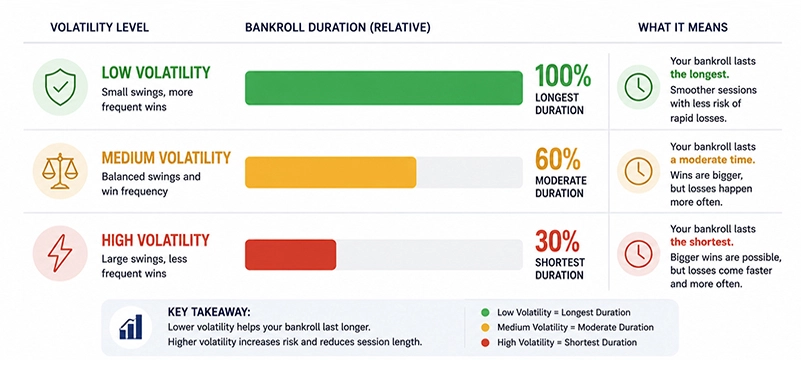
This infographic illustrates the relationship between game volatility and bankroll longevity. Lower-volatility games typically provide more frequent wins and longer playing sessions, while higher-volatility games often create larger bankroll swings that can shorten the average session despite the potential for bigger payouts.
Source: Educational illustration based on common volatility characteristics used in online casino game analysis and player guidance materials (2026).
In general, bankroll duration tends to decline as volatility increases. While every session is different, higher-volatility games usually produce greater variance and larger short-term fluctuations.
This relationship is particularly relevant for players focused on responsible bankroll management.
Low Volatility Games
Low-volatility games typically produce smaller wins more often.
Players may see their balance move up and down gradually rather than experiencing dramatic swings. While large payouts are usually less common, regular smaller wins can help sessions feel more stable.
For beginners, low-volatility games are often easier to understand because bankroll changes tend to be less extreme. Players can usually enjoy longer sessions without needing a large starting balance.
This does not eliminate risk, but it often reduces the intensity of short-term fluctuations.
Medium Volatility Games
Medium-volatility games sit between stability and risk.
These games generally combine reasonably frequent wins with occasional larger payouts. Many popular online slots fall into this category because they appeal to a wide range of players.
A medium-volatility game can provide enough action to keep gameplay engaging while avoiding some of the larger bankroll swings associated with high-volatility titles.
For many beginners, medium volatility offers a balanced introduction to online casino games.
High Volatility Games
High-volatility games are designed differently.
Wins tend to occur less frequently, but larger payouts are usually possible when they do appear. This can create long stretches without significant returns followed by occasional high-value wins.
Because of these larger fluctuations, bankrolls can disappear faster during short sessions, even when the game's RTP is relatively high.
Many experienced players enjoy high-volatility games because of their larger payout potential, but beginners should understand that these games often require greater bankroll discipline and realistic expectations.
Why RTP Alone Does Not Predict Results
One of the most common beginner mistakes is assuming that a high RTP guarantees better outcomes.
Imagine two slots:
Slot A: 96.5% RTP, High Volatility
Slot B: 95.8% RTP, Low Volatility
Despite the higher RTP, Slot A may feel far more difficult during a short session because long losing streaks are more common.
RTP describes long-term expectations.
Volatility describes short-term experience.
This distinction is one of the most important concepts new players can learn.
Why Casino Reviews Often Mention RTP
RTP appears frequently in casino reviews because it offers a standardized way to compare games.
When two slots offer similar themes or features, RTP can help players understand which game theoretically returns more money over the long run. This is one reason RTP is commonly included in game databases, provider information, and casino review platforms.
However, RTP alone never tells the whole story.
A game with a 97% RTP and high volatility may feel very different from a game with a 95.5% RTP and low volatility. One may produce long losing streaks, while the other delivers smaller wins more consistently.
This is why quality casino reviews typically evaluate RTP alongside volatility, game mechanics, payout structure, and overall player experience rather than focusing on a single percentage.
Can Players Use RTP to Choose Games?
Yes—but with realistic expectations.
RTP can be a useful comparison tool when evaluating similar games. If two slots offer comparable gameplay and one has a significantly higher RTP, many players would view that as a positive factor.
At the same time, RTP should never be treated as a prediction tool.
A game with a 97% RTP can still produce losses during a short session, while a lower-RTP game can occasionally generate large wins.
The most practical approach is to evaluate RTP alongside volatility.
For example:
- Higher RTP + Low Volatility may appeal to players seeking longer sessions.
- Higher RTP + High Volatility may appeal to players comfortable with larger swings.
- Lower RTP + High Volatility generally involves greater risk and shorter bankroll durability.
Understanding this relationship can support better bankroll planning and more realistic expectations about gameplay outcomes.
Common Beginner Misunderstandings
Several myths appear frequently among new casino players.
“A 96% RTP means I will get back CA$96 from every CA$100.”
No. RTP reflects long-term averages across huge sample sizes.
“High RTP guarantees profits.”
No casino game guarantees profits. RTP only affects theoretical expectations.
“Low volatility means no risk.”
All casino games involve risk. Low volatility simply tends to reduce fluctuations.
“House Edge and RTP are unrelated.”
They are directly connected and describe the same mathematical framework.
“Recent losses increase the chance of winning.”
Casino games use random outcomes. Previous results do not change future probabilities.
Using RTP, House Edge, and Volatility Responsibly
These metrics are best viewed as educational tools rather than winning strategies.
Canadian players can use them to:
- compare games objectively
- understand risk levels
- choose experiences that fit their bankroll
- set realistic expectations
- avoid common misconceptions
They can also help players recognize when entertainment is turning into unrealistic expectations about recovering losses or guaranteeing profits.
These concepts also complement broader topics such as bankroll management, bonus evaluation, responsible gambling, and understanding how casino games are reviewed and compared.
Conclusion
RTP, House Edge, and Volatility are among the most useful concepts for understanding how casino games work.
RTP explains long-term return expectations. House Edge shows the casino's mathematical advantage. Volatility describes how wins and losses are distributed during actual gameplay.
Viewed together, these metrics provide a clearer picture of risk, bankroll behavior, and realistic expectations, making them essential knowledge for any Canadian player learning how online casino games operate.
Understanding RTP, House Edge, and Volatility will not guarantee better outcomes or winning sessions. However, these concepts can help players approach casino games with more realistic expectations, stronger bankroll awareness, and a clearer understanding of how risk and probability influence the overall experience. This knowledge is valuable not only when choosing games, but also when developing responsible gambling habits and making informed decisions over the long term.